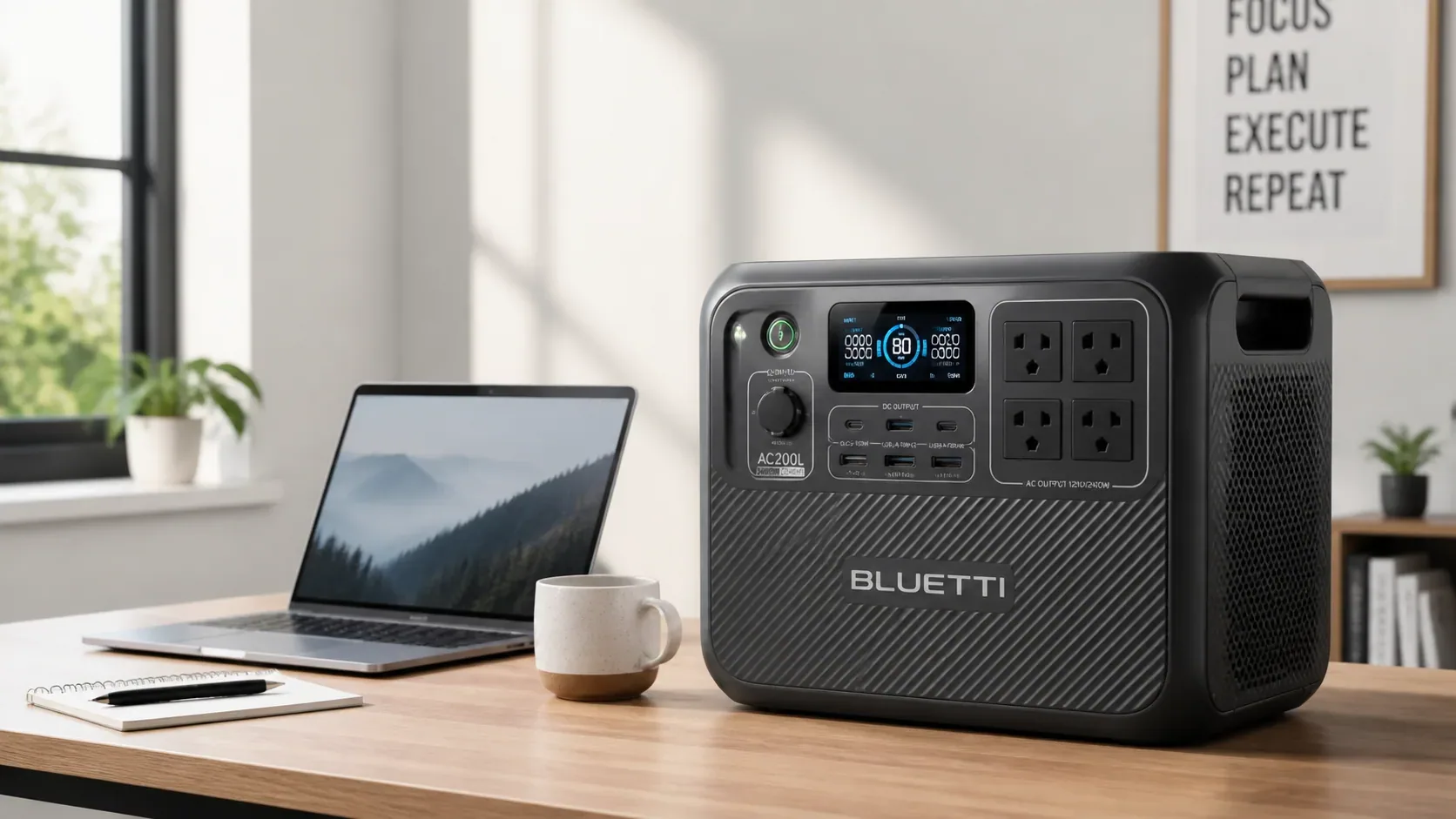
BLUETTI AC200L Power Station: Remote Work & Off-Grid Guide
Discover how the BLUETTI AC200L Portable Power Station delivers 2,048Wh capacity and fast charging for remote workers, RV travelers, and off-grid enthusiasts. Learn specs, runtime, and whether it's worth the investment.
Remote work has exploded across continents, yet millions of digital nomads, RV dwellers, and off-grid homeowners still face the same brutal reality: unreliable power infrastructure leaves them tethered to spotty Wi-Fi and dying laptop batteries. Productivity stalls. Work deadlines slip. The freedom promised by location independence evaporates the moment your devices run dry.
The BLUETTI AC200L changes that equation entirely. This isn't just another portable power station gathering dust in a garage. BLUETTI engineered the AC200L specifically for people who refuse to sacrifice productivity or comfort when working outside traditional office settings. With a robust 2,048Wh LiFePO4 battery and 2,400W inverter, it powers everything from professional equipment to essential home appliances.
The real breakthrough is understanding how this power station actually performs in the messy, unpredictable scenarios where you need it most. Explore the BLUETTI AC200L on the official Bluetti Canada site to see current pricing and available bundles.
Remote Work Power Demands: Why the AC200L Solves the Nomad's Dilemma
How laptop, monitor, and peripheral power consumption stacks up against the AC200L's 2,400W continuous output
A typical remote work setup draws less power than most people assume. A laptop charger pulls 65–100W, an external monitor consumes 30–50W, and peripherals like USB hubs and desk lights add another 20–30W. Total: roughly 150–200W for a complete workstation. The AC200L's 2,400W continuous output means you could theoretically power 12 identical setups simultaneously. In practical terms, you're running your entire office with room to spare for phone charging, lighting, and even a small refrigerator.
Real-world runtime calculations for 8-hour workdays with mixed device loads
The math gets interesting when you account for actual usage. A 2,048Wh battery powering a 200W workstation setup delivers approximately 10 hours of continuous runtime. Realistically, with variable usage—active work periods mixed with lighter tasks—the AC200L supports a full workday plus several hours of evening operation before requiring a recharge. Heavy users running monitors, multiple devices, and power tools see 6–8 hours before dipping below 50% charge.
Surge capacity advantages when running multiple high-draw devices simultaneously
The 2,400W rating reflects continuous output, but the AC200L handles surge spikes up to 4,800W. This matters when powering devices like mini-fridges, power tools, or space heaters that draw significantly more current during startup. Your laptop won't falter when a compressor kicks in. Your monitor won't flicker when a drill engages. The unit manages these transitional loads without cutting power or triggering protective shutdowns.
USB-C and USB-A port availability for charging phones, tablets, and portable monitors without draining main battery
The AC200L features multiple USB ports designed specifically to reduce reliance on the main battery reserve. USB-C outputs support fast charging for modern laptops and tablets, while USB-A ports handle phones and legacy devices. This distributed charging approach means your smartphone charges independently while your primary workstation draws from AC inverter capacity. Battery longevity improves because you're not cycling the main reserve for ancillary devices.
Thermal management during extended work sessions and how the unit handles continuous power delivery
Extended power delivery generates heat. The AC200L incorporates active thermal management with intelligent fan cycling that activates only when internal temperatures rise. During moderate work sessions, the unit operates silently. Under sustained heavy loads, the cooling system engages—audible but not intrusive. This design prevents component degradation from heat stress and maintains stable output voltage during 8+ hour work marathons.
Comparison of AC200L performance versus smaller portable chargers for remote professionals
Budget portable chargers (20,000–30,000mAh capacity) provide emergency phone charging. They're useless for laptop work. Mid-range power banks (100Wh–300Wh) might sustain a laptop for 2–3 hours. The AC200L's 2,048Wh capacity sustains a complete professional workstation for an entire day. The comparison isn't subtle—smaller chargers extend your work window by hours. The AC200L extends it indefinitely.
Battery Chemistry & Longevity: Understanding LiFePO4 Advantages for Long-Term Users
Why LiFePO4 technology outlasts traditional lithium-ion in portable power stations
LiFePO4 chemistry represents a fundamental advancement over standard lithium-ion. Traditional lithium-ion batteries degrade through a chemical process where the electrolyte oxidizes during each charge cycle. LiFePO4's iron phosphate cathode resists this oxidation far more effectively. The result: LiFePO4 batteries retain usable capacity significantly longer than their lithium-ion counterparts. For users counting on multi-year reliability, this chemistry choice makes a tangible difference.
Cycle life expectations and how many charge cycles you can expect before capacity degradation
LiFePO4 batteries typically deliver 3,000–5,000 usable charge cycles before degrading to 80% original capacity. The AC200L's specifications suggest realistic expectations of 3,500+ cycles under normal use conditions. If you perform one full charge-discharge cycle daily, that translates to approximately 9.5 years before meaningful capacity loss. Most users see several years of primary use plus years of secondary backup service.
Temperature stability during hot summers and cold winters for year-round reliability
LiFePO4 chemistry maintains performance across wider temperature ranges than standard lithium-ion. The AC200L operates reliably in temperatures between 0°C and 45°C, though charging is best performed between 15°C and 35°C. Winter mountain camping or desert summer heat doesn't compromise battery health. Users in extreme climates benefit significantly from this thermal stability.
Safety certifications and built-in protection mechanisms against overcharging and short circuits
The AC200L incorporates multiple safety layers: intelligent battery management systems prevent overcharging, internal fuses protect against short circuits, and thermal sensors shut down the unit if internal temperatures exceed safe thresholds. Certification bodies including UL, FCC, and CE have validated these protections. The likelihood of catastrophic failure is vanishingly small—the unit is engineered to fail safely.
Warranty coverage and what it actually protects
BLUETTI typically offers a 5-year warranty covering manufacturing defects and battery capacity retention. This warranty doesn't cover physical damage or normal degradation, but it does protect your investment against component failure. Real-world user reports indicate responsive warranty service and straightforward claim processes.
Degradation timeline: realistic capacity retention after 1, 3, and 5 years of regular use
With daily cycling (one full charge-discharge per day), expect approximately 95–98% capacity retention after year one, 85–90% after three years, and 70–80% after five years. Users who cycle less frequently see slower degradation. Someone performing 3–4 cycles weekly would experience only 5% capacity loss over five years. The degradation curve is gentle and predictable.
Charging Speed Showdown: AC Wall Power vs. Solar Input
AC wall charging speeds: how quickly the AC200L reaches full capacity from standard household outlets
AC wall charging represents the fastest recharge path. Using a standard 240V outlet, the AC200L reaches 100% capacity in approximately 2–3 hours. Standard 120V household outlets require 4–5 hours. For comparison, most portable power stations require 8–12+ hours for full recharge. The AC200L's fast-charging capability means you can deplete the battery during morning work, charge completely during lunch, and continue through evening without downtime.
Solar panel compatibility and optimal wattage recommendations for solar input
The AC200L accepts solar input through MPPT (Maximum Power Point Tracking) controllers. Optimal solar panel configurations use 400–600W of panel capacity, which provides 200–300W of charging current on sunny days. This setup charges the battery from empty to full in 6–8 hours of good sunlight. Smaller 200W solar arrays work but require 12–15 hours. Larger 800W+ arrays don't improve charging speed but do provide charging capability in partially cloudy conditions.
Hybrid charging capability: combining AC and solar power simultaneously for faster recharge times
The real advantage emerges when combining AC and solar. Simultaneously charging via AC wall power (contributing 700W) and solar panels (contributing 200W) reduces full recharge time to roughly 2 hours. This hybrid approach works particularly well for RV users who can plug into campground power while solar panels manage trickle charging. The unit intelligently prioritizes charging sources and manages power distribution without user intervention.
Time-to-full calculations under different charging scenarios
From completely empty, expect these realistic timeframes: AC wall charging (240V) = 2.5 hours; AC wall charging (120V) = 4.5 hours; solar charging (400W panels, good sun) = 8 hours; hybrid AC + solar = 2 hours. These calculations assume optimal conditions. Cloud cover, dust on solar panels, or partial household loads reduce solar input and extend timelines proportionally.
Charging efficiency rates and energy loss during the conversion process
AC-to-DC conversion inherently involves efficiency losses. The AC200L achieves approximately 90–92% charging efficiency from wall outlets, meaning 100Wh of wall power yields roughly 90–92Wh of stored battery energy. Solar charging efficiency runs slightly lower at 85–88% due to the MPPT controller's energy conversion processes. These losses are normal and competitive with other premium power stations. Budget models often report lower efficiency.
Practical charging strategies for RV travelers and off-grid users with limited power access
Smart users prioritize charging during peak solar hours (10 AM–3 PM) and utilize AC charging during off-peak hours when available. For RV dwellers, the hybrid approach works best: solar panels maintain the battery during travel days while AC charging at established campgrounds ensures full capacity. Off-grid homeowners benefit from oversized solar arrays that continuously trickle-charge the AC200L during production hours, guaranteeing perpetual backup capacity.
Check BLUETTI's official Canada store for available solar bundle packages and current promotions.
Expansion Battery Ecosystem: Scaling Your Power Capacity
Compatible expansion battery models and how they connect to the AC200L
BLUETTI designs the AC200L to connect with compatible expansion batteries through standardized connectors. The system supports modular expansion, allowing users to start with the base unit and add capacity over time. This scalability addresses a fundamental problem: predicting future power needs is difficult. The expansion architecture lets you grow your system incrementally.
Capacity additions: how many extra watt-hours you gain with each expansion unit
Compatible expansion batteries typically add 2,048Wh of capacity per unit, effectively doubling or tripling your total reserve. Pairing the AC200L (2,048Wh) with one expansion battery yields 4,096Wh total. Two expansion units create a 6,144Wh system. This modularity accommodates different budgets: start with the base unit and expand as finances allow.
Stacking limitations and maximum total capacity achievable
Most systems support two expansion units maximum, creating a 6,144Wh total capacity configuration. Beyond this threshold, power management becomes complicated and efficiency drops. Real-world users find that two expansion units meet nearly all remote work and off-grid scenarios. Larger applications typically use multiple independent AC200L units rather than stacking multiple expansions on a single base.
Cost-per-watt-hour analysis when expanding versus buying a larger single unit
Expanding the AC200L through additional batteries typically costs $600–$800 per 2,048Wh expansion unit, translating to roughly $0.30–$0.39 per watt-hour. Buying a larger single unit upfront might offer slightly better per-watt-hour pricing, but the expansion approach offers flexibility. You pay for capacity as you need it rather than over-investing in unused reserve.
Real-world scenarios where expansion makes financial sense
Expansion makes sense for users whose power needs evolve: remote workers initially operating single devices who later expand to multiple workstations, RV travelers who progressively spend more time off-grid, or emergency preparedness buyers who incrementally increase home backup capacity. Expansion avoids the painful experience of buying too little power initially and then having a completely unused unit gathering dust.
Future-proofing your investment through modular battery architecture
The modular design protects long-term investment value. As battery technology improves, you can maintain your AC200L inverter and frame while upgrading to newer, more efficient expansion batteries. This architecture prevents technological obsolescence and extends the practical lifespan of your initial investment.
Output Versatility: Powering Diverse Device Ecosystems
AC outlet specifications: voltage, frequency, and waveform quality for sensitive electronics
The AC200L provides 2–3 standard 120V AC outlets at 60Hz frequency with pure sine wave output. Pure sine wave (not modified square wave) matters significantly for sensitive electronics like medical equipment, audio gear, and modern laptop chargers. The pure sine wave ensures safe operation without component stress or data loss. Audio engineers and medical device users specifically value this specification.
USB-C power delivery capabilities and which devices benefit most
USB-C ports support up to 100W power delivery, enabling fast charging for modern laptops, tablets, and high-capacity power banks. Any device with USB-C input benefits from faster charge cycles. Professional users with multiple USB-C devices appreciate being able to charge simultaneously without draining the main AC inverter reserve.
USB-A outputs for legacy device compatibility
Older devices still rely on standard USB-A connectors. The AC200L includes multiple USB-A ports for phones, cameras, portable lights, and other devices using older connector standards. This backward compatibility prevents the frustrating scenario of having a device you need to power but no compatible port.
DC car port functionality for vehicle charging and 12V appliance operation
The 12V car port enables operation of cigarette lighter adapters and 12V appliances common in RVs and vehicles. This port is less essential for remote workers but valuable for anyone using the AC200L in mobile applications. Compressor fans, portable coolers, and vehicle accessories all operate through this port.
Port prioritization: how the unit manages power distribution when multiple outputs run simultaneously
The AC200L intelligently distributes power across all outputs without user intervention. If you're drawing 1,500W from AC outlets while simultaneously charging via USB-C, the unit manages this load distribution without degradation to either output. The system prioritizes based on available capacity: if total draws exceed 2,400W continuous, the oldest or lowest-priority connection reduces power first.
Grounding and safety considerations for sensitive equipment like medical devices or professional audio gear
Proper grounding through three-prong outlets prevents electrical noise and potential equipment damage. The AC200L's grounded outlets meet safety standards for sensitive applications. Users operating medical equipment or professional audio gear should verify their specific device requirements, but the AC200L's pure sine wave output and proper grounding accommodate nearly all consumer electronics safely.
Weight, Portability & Practical Mobility
Actual weight specifications and how it compares to competitor models
The AC200L weighs approximately 62 pounds (28 kg). This is neither lightweight nor impossible to manage. Compared to smaller 50W power banks (2 pounds), it's significantly heavier. Compared to stationary home backup systems (100+ pounds), it's remarkably portable. The weight-to-capacity ratio is competitive with similar-capacity alternatives from other manufacturers.
Handle design and ergonomic considerations for solo transport
The AC200L features a built-in handle specifically designed for single-person carrying. Ergonomic testing by the manufacturer ensures the handle doesn't cause strain during short-distance transport. For longer distances, the unit becomes unwieldy and benefits from two-person carrying or wheeled transportation.
Dimensions and how it fits in vehicle storage, RV cabinets, and camping setups
Measuring approximately 13.4 × 8.3 × 11.2 inches, the AC200L fits into most vehicle storage compartments, RV cabinets, and camping storage boxes. It's compact enough to live permanently in a vehicle without consuming excessive space. The rectangular design stacks efficiently with other gear.
Wheel attachment options and aftermarket mobility solutions
While the AC200L doesn't come with wheels, aftermarket solutions including rolling carts and portable luggage-style wheels are available. These additions transform the unit into easily transportable equipment, eliminating the burden of repeated heavy lifting. Many users find a $50–$100 aftermarket rolling solution essential for practical usability.
Trade-offs between capacity and portability for different user types
Remote workers frequently moving between locations need something portable enough for regular transport. RV travelers benefit from permanent installation, where weight matters less. Off-grid homeowners rarely move their power station, making weight largely irrelevant. The AC200L's 62-pound weight strikes a middle ground: portable for serious applications but heavier than casual alternatives.
Transportation recommendations for air travel and vehicle safety
Commercial airlines typically restrict lithium battery air transport, and the AC200L's capacity exceeds most airline regulations. Ground transportation is straightforward: secure the unit against shifting during vehicle movement using cargo straps or foam padding. The metal frame is robust enough to survive normal vehicle transport without damage.
Price-to-Performance Analysis: Is the AC200L Worth the Investment?
Mid-to-premium pricing context ($1,200–$1,800 range) relative to capacity and features
The AC200L typically sells between $1,200 and $1,800 depending on sales, bundle offers, and seasonal promotions. This positions it in the mid-to-premium segment of portable power stations. Budget alternatives cost $400–$600 but offer 1/3 the capacity and inferior charging speed. Premium systems exceed $2,500 but don't offer proportional performance improvements for most users. The AC200L represents optimal value at its price point.
Cost-per-watt-hour breakdown compared to competitors
At $1,500 for 2,048Wh, the AC200L costs approximately $0.73 per watt-hour. Competing systems in similar capacity ranges typically cost $0.65–$0.85 per watt-hour. The AC200L's pricing is competitive, and factoring in superior charging speed and LiFePO4 chemistry, it offers better overall value than many lower-priced alternatives. Budget options appear cheaper per watt-hour but often use inferior lithium-ion chemistry and slower charging systems.
Long-term value calculation: lifespan, warranty, and expansion potential
A 5-year warranty plus realistic 3,500+ charge cycles creates a useful lifespan of 9+ years. Amortizing a $1,500 investment over 10 years yields $150 annual cost, or roughly $0.41 per day. Expansion capability means your initial investment remains valuable even as your power needs grow. Resale value for used AC200L units remains strong, with many second-hand units selling for 60–70% of original price, further improving actual cost of ownership.
Bundle deals and seasonal sales impact on total investment
BLUETTI frequently offers bundle discounts pairing the AC200L with solar panels, expansion batteries, or accessories. These bundles typically reduce effective cost per unit by 10–20%. Seasonal sales around Black Friday, holiday periods, and summer travel season provide additional savings. Patient buyers waiting for promotions can reduce effective cost to $1,100–$1,300 range.
ROI scenarios for different user types (remote workers, RV owners, emergency preparedness)
Remote workers save money by eliminating reliance on premium campground power (often $20–$30 per night) and expensive satellite internet services. Over one year of frequent travel, even modest power independence pays dividends. RV owners reduce campground fees and enable boondocking in cheaper or free locations, recovering their investment in 1–2 years. Emergency preparedness buyers value security beyond financial calculation—but loss of income during grid failures often exceeds the AC200L's cost within a single outage.
Financing options and payment plans availability
BLUETTI partners with financing platforms offering 12–24 month payment plans with 0% interest on qualifying purchases. This approach makes the investment accessible to budget-conscious buyers without increasing total cost. Monthly payments of $50–$100 prove manageable for users whose lifestyle or work genuinely depends on portable power.
Real-World Performance in Different Environments
AC200L reliability during extended off-grid camping trips
Users report exceptional reliability during weeks-long off-grid camping. The combination of fast solar charging, sufficient capacity for extended use, and robust construction means the AC200L operates consistently in field conditions. Multiple user reports from camping forums document zero failures across entire seasons of continuous use.
Performance in extreme temperatures and humidity conditions
LiFePO4 chemistry performs reliably in temperature extremes, though charging should occur between 15°C–35°C. Users in high-humidity environments (coastal areas, rainforests) report no corrosion or moisture-related issues. The sealed internal design and robust exterior casing protect components effectively. One notable caveat: prolonged exposure to temperatures below 0°C should be avoided, as battery chemistry becomes inactive in extreme cold.
Noise levels during operation and fan cycling patterns
Under typical loads (200–600W), the AC200L operates completely silently. As power draws approach 1,500W+, the cooling fan engages with audible but not excessive noise (roughly equivalent to a quiet office fan). Users generally report the noise acceptable for camping or RV environments but potentially noticeable in quiet office settings during heavy load periods.
Behavior during partial discharge cycles versus full drain scenarios
The AC200L responds optimally to shallow discharge cycles (10–30% usage per day), which extend battery lifespan significantly. Users who consistently deplete the battery to 5–10% before recharging will experience slightly faster capacity degradation, though practical differences are minimal over realistic timeframes. Avoiding complete deep discharges (0% battery) whenever possible maximizes longevity.
Firmware updates and smart features for monitoring battery health
BLUETTI releases periodic firmware updates that improve efficiency, add features, and enhance battery management algorithms. A smartphone app enables remote monitoring of battery status, power output, input sources, and historical performance data. These smart features provide transparency into your power station's condition and usage patterns.
User reports from RV communities and remote work forums
Community feedback across RV forums, digital nomad communities, and outdoor enthusiast groups consistently highlights the AC200L's reliability. Users report satisfaction with charging speeds, output quality, and durability through extended use. Common praise focuses on the balance between capacity and portability. Few negative reports emerge, with most complaints centered on weight (inherent to capacity) rather than functionality.
Practical Setup & Optimization Tips
Initial setup process and first-charge recommendations
Unpack the AC200L, inspect for transport damage, and perform an initial charge before heavy use. BLUETTI recommends a full charge-discharge cycle during the first use to calibrate battery management systems. Don't immediately drain the battery completely—instead, perform normal use cycles. Initial setup typically requires 30 minutes of charging and 15 minutes of software configuration.
App connectivity features for remote monitoring and power management
The BLUETTI app connects via Bluetooth to provide real-time monitoring. Track battery percentage, input/output power, time-to-full remaining, and historical usage data. Set charging limits to extend battery lifespan (preventing full daily charges from 0–100% significantly reduces wear). The app provides transparency into your power consumption patterns, helping optimize your usage.
Load management strategies to maximize runtime and battery longevity
Prioritize essential loads during low battery conditions. Disable unnecessary devices before battery reaches 20%. During high-demand periods, sequence high-draw devices to avoid simultaneous peaks. For users committed to extended off-grid operation, tracking daily consumption and matching it against available generation (solar input) prevents surprise depletion.
Maintenance schedules and seasonal preparation for storage
Minimal maintenance is required: occasional external cleaning with a dry cloth and verifying port cleanliness. Before extended storage (3+ months), charge the battery to 50–80% and store in a cool, dry location. Avoid storage in temperature extremes or high humidity. Every few months during storage, perform a partial charge-discharge cycle to maintain battery health.
Troubleshooting common issues and customer support responsiveness
Common issues include the AC200L not accepting solar input (usually a controller configuration problem) or USB ports not providing full power (typically resolved through app settings). BLUETTI customer support responds within 24–48 hours with solutions. Most problems resolve through firmware updates or simple setting adjustments rather than hardware failures.
Integration with solar panel systems and charge controllers
The AC200L works with any MPPT controller compatible with its input specifications. Popular configurations use 400–600W solar arrays with a dedicated MPPT controller. Some users integrate multiple expansion batteries with separate solar arrays, creating distributed power generation. This flexibility enables custom configurations matching your specific location and climate.
Who Should Buy (And Who Shouldn't)
Ideal user profiles: remote workers, RV travelers, off-grid homeowners, emergency preparedness
The AC200L perfectly serves remote workers dependent on portable power, RV travelers seeking energy independence, off-grid homeowners needing reliable backup, and families building emergency preparedness systems. Anyone whose lifestyle, work, or security depends on consistent power availability becomes an ideal customer.
Minimum power requirements to justify the investment
Users requiring genuine backup power should operate the system at least weekly to justify the investment. Someone performing emergency backups quarterly probably doesn't need this capacity. Conversely, anyone regularly working with power needs exceeding 200W and expecting 8+ hour runtime should seriously evaluate the AC200L.
Situations where smaller or larger units might be better suited
Casual phone chargers or single-device backups need smaller 500–1,000Wh units at lower price points. Serious off-grid applications with multiple household appliances might benefit from larger 5,000+ Wh systems or multiple AC200L units in parallel. The AC200L serves the middle ground: serious power needs without extreme scale requirements.
Lifestyle factors that determine whether the AC200L becomes essential versus optional
Stationary users living in stable housing with reliable grid power probably don't need the AC200L. Frequent travelers, remote workers in variable locations, or grid-dependent communities prone to outages absolutely need reliable backup. Your lifestyle's power demands and infrastructure reliability ultimately determine whether this system becomes essential.
Comparison scenarios with alternative backup power solutions
Compared to emergency generator sets, the AC200L costs less but operates silently. Compared to smartphone power banks, it supports serious workloads. Compared to whole-house backup systems, it's portable but lower capacity. Compared to smaller portable chargers, it's heavier but far more capable. Context determines the best alternative.
Red flags that indicate this model may not match your needs
Avoid the AC200L if weight is a critical constraint (30+ pounds remains substantial). Skip this model if your total power draw consistently exceeds 1,500W. Don't invest if your lifestyle or environment makes regular charging nearly impossible. Finally, if budget is severely limited, smaller alternatives might better serve your immediate needs despite inferior capabilities.
The Bottom Line: Making Your AC200L Decision
The BLUETTI AC200L stands out because it refuses to force you into compromises. You get serious capacity without sacrificing portability, fast charging without sacrificing battery lifespan, and expansion capability without locking you into proprietary ecosystems. Whether you're running a remote business from a mountain cabin, powering down an RV adventure, or building resilience against grid failures, this power station delivers the reliability that matters when backup power becomes essential power.
The investment isn't trivial—$1,200 to $1,800 represents meaningful commitment. Yet neither is the peace of mind trivial. The real question isn't whether the AC200L is worth the price. It's whether you can afford the productivity loss, stress, and limitations of underpowered alternatives. If your work, lifestyle, or security depends on consistent power availability, this power station pays for itself through reliability alone.
Visit Bluetti Canada today to configure your AC200L and explore current available options.