Joyreal Wooden Balance Blocks: Montessori Toy
Discover how Joyreal Toys Wooden Balance Blocks build fine motor skills and spatial reasoning in preschoolers. Learn what makes these Montessori-style blocks a top choice for parents seeking screen-free, educational play.
Research shows that over 85% of child development experts recommend hands-on, screen-free toys as essential tools for early learning—yet most parents struggle to find options that genuinely engage their children while building real skills. The pressure to choose wisely can feel overwhelming when toy aisles overflow with plastic gadgets and overstimulating electronics.
What if there was a simple, proven solution that children actually beg to play with? Joyreal Toys Wooden Balance Blocks have become a cornerstone product in the Montessori-inspired toy movement, capturing the attention of educators and parents alike. These thoughtfully designed wooden sets combine aesthetic appeal with genuine developmental benefits—offering a refreshing alternative to screen time.
The brand's commitment to quality construction and child-safe materials has earned them recognition as a trusted choice for families prioritizing intentional play. You'll discover specific features that set these blocks apart, practical ways to maximize their educational potential, and honest insights about whether they're the right fit for your family's needs.
How Joyreal Wooden Balance Blocks Support Early Childhood Development
Fine Motor Skill Advancement
Grasping, stacking, and precise placement of wooden blocks naturally strengthen the small muscles in children's hands and fingers. As children manipulate each piece, they develop the dexterity required for writing, drawing, and self-care tasks. The varied shapes and sizes encourage experimentation with different gripping techniques and hand positions.
Hand-Eye Coordination Enhancement
Balancing challenges and spatial awareness tasks create natural opportunities for children to refine their hand-eye coordination. Each attempt to balance a block teaches the visual feedback needed for precise motor control. This coordination foundation supports athletic development, academic writing, and everyday physical tasks throughout childhood and beyond.
Problem-Solving Abilities
Open-ended play sessions with wooden blocks foster natural problem-solving as children encounter the challenge of creating stable structures. Trial-and-error learning emerges organically without external pressure or prescribed solutions. Children discover principles of balance, symmetry, and structural integrity through experimentation rather than instruction.
Cognitive Development Through Pattern Recognition
Arranging blocks by color, size, or shape introduces foundational concepts of categorization and patterns. As children progress, they begin recognizing relationships between pieces and experimenting with sequences. This cognitive engagement builds the mental frameworks that support mathematical thinking and logical reasoning.
Social-Emotional Growth
When children play cooperatively with peers, blocks become tools for communication and collaboration. Sharing pieces, taking turns, and building together create opportunities to practice patience, negotiate ideas, and celebrate collective achievements. These interactions build emotional intelligence and social competence.
Confidence Building
Each successfully completed structure represents a genuine accomplishment. Children experience the satisfaction of mastery as they progress from simple two-block towers to increasingly complex balancing challenges. This earned confidence extends beyond play, influencing their willingness to attempt new challenges in other areas.
What Makes the Design and Construction Stand Out
Premium Wood Sourcing and Durability
Joyreal Toys sources wood that delivers smooth-finished surfaces resistant to splinters and wear. The material selection ensures pieces maintain their integrity through countless uses, washing, and storage. Durability translates to better long-term value and safer play experiences.
Child-Safe Paint Formulations
Non-toxic, child-safe paint meets rigorous safety standards for young learners. The color application is consistent and resistant to chipping, protecting children from paint ingestion while maintaining the visual appeal that attracts continued interest. This commitment to safety reflects thoughtful product development from conception through production.
Varied Shapes and Sizes
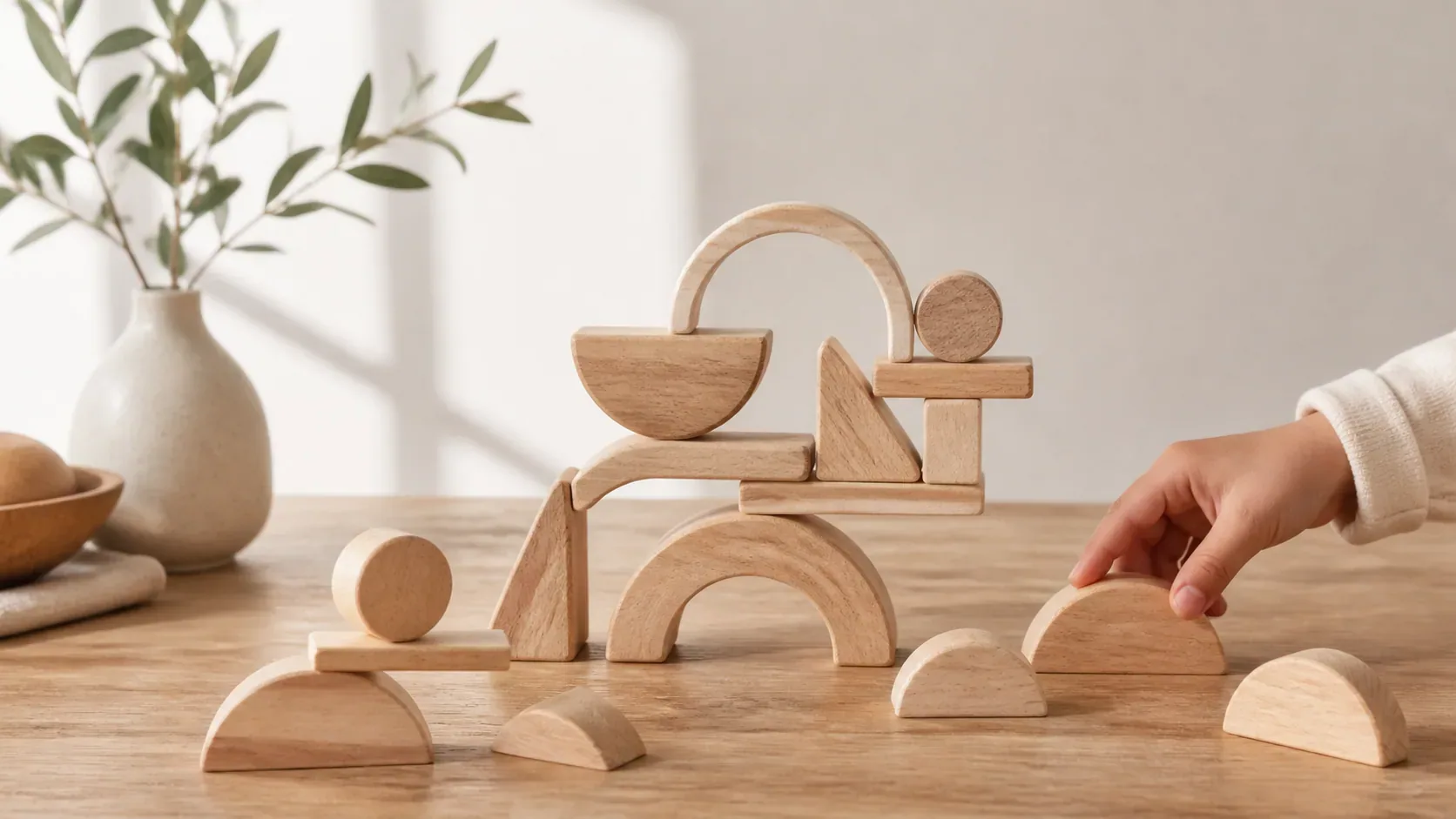
The collection includes cubes, rectangles, cylinders, and other geometric forms that encourage creative exploration. Different sizes create natural progression in difficulty level—smaller pieces for younger children and larger sets for more advanced builders. Shape variety transforms the blocks from a single-use toy into a versatile tool supporting multiple types of play.
Vibrant, Appealing Color Palettes
Carefully chosen colors attract and maintain children's interest without overwhelming their visual systems. The palette balances vibrancy with sophistication, appealing equally to children and parents who share play spaces. Colors also support early learning concepts like sorting and pattern-making.
Thoughtful Weight Distribution
Each piece features realistic weight distribution that provides genuine balancing feedback. Pieces are neither too heavy nor too light—they respond authentically to placement, teaching children actual physics principles. This authenticity deepens learning compared to toys with artificial or unpredictable weight distributions.
Lightweight Yet Sturdy Construction
The construction prevents frustration by keeping pieces manageable for small hands while remaining sturdy enough for repeated use. Children can build independently without exhaustion, maintaining engagement and motivation throughout play sessions.
Age-Appropriate Play: Which Children Benefit Most
Preschoolers (Ages 3-5)
Preschoolers represent the primary audience, as their developing fine motor skills and emerging problem-solving abilities align perfectly with block-building activities. At this stage, children thrive with open-ended play that supports independence while building competence. The variety in the set sustains interest across multiple play sessions.
Toddlers (Ages 2-3)
Toddlers require close supervision due to small piece sizes and the natural tendency to explore objects orally. Despite the supervision requirement, many children at the younger end of this range engage meaningfully with larger blocks under watchful eyes. Parents should assess individual readiness based on their child's development rather than relying solely on age guidelines.
Kindergarteners
Kindergarten-aged children use blocks for increasingly complex architectural and engineering challenges. At this stage, they benefit from the developmental progression—moving from basic stacking to intentional design, creating structures with specific purposes and planned layouts. The blocks support curriculum connections to math and science concepts.
Mixed-Age Group Play
Scenarios where older siblings mentor younger children transform blocks into vehicles for relationship-building. Older children develop leadership and patience while younger ones benefit from guided play and modeling. These mixed-age dynamics create rich learning opportunities beyond what age-matched play provides.
Classroom Settings
Teachers integrate blocks into structured learning activities, using them for sensorial exploration, practical life lessons aligned with Montessori approaches, and group problem-solving challenges. The classroom context allows for guided progression and documentation of developmental milestones.
Developmental Readiness Indicators
Parents should watch for signs of readiness: sustained attention during play, interest in stacking or organizing objects, ability to follow simple two-step instructions, and demonstrated hand strength. Children showing these indicators will maximize the learning benefits, regardless of exact age.
Comparing Price Points and Value Across Different Sets
Budget-Friendly Entry-Level Sets ($15-$20)
Smaller piece counts work well for casual play or families new to wooden blocks. These sets introduce children to the concept without significant financial commitment. They're ideal for testing whether wooden blocks align with your child's interests before investing more substantially.
Mid-Range Options ($25-$35)
Expanded piece variety and included storage solutions support more advanced play and organization. These sets typically offer better value per piece while providing storage that encourages independent cleanup and asset management. Mid-range options strike a balance between affordability and developmental benefit.
Cost-Per-Piece Analysis
Calculating cost per piece reveals that larger sets often deliver better value despite higher upfront investment. A set containing 50 pieces at $30 offers lower cost per piece than 25 pieces at $20. However, consider storage space and whether your child will use all pieces—a smaller set fully utilized provides better value than an oversized collection with unused pieces.
Retailer Variations and Pricing Fluctuations
Price varies across retailers and platforms, with seasonal sales and promotions offering opportunities for savings. Checking multiple sources before purchasing typically reveals 10-20% price differences. Building relationships with trusted retailers can provide access to advance notice of sales and exclusive pricing.
Long-Term Value Assessment
Consider durability and multi-child use potential when evaluating long-term value. A set used by one child for three years, then passed to a younger sibling, delivers significantly better value than short-lived plastic alternatives. Wooden blocks gain sentimental value as children create memories and grow through play.
Return on Investment Through Developmental Benefits
Developmental toys that grow with children offer superior return on investment compared to entertainment-only options. Blocks used for fine motor skill development at age 3, architectural exploration at age 5, and collaborative engineering projects at age 7 justify their cost through years of engagement.
Compare Joyreal block sets to find the perfect size and price point for your family's needs.
Real-World Play Scenarios and Learning Applications
Solo Play Sessions
Children build independence and self-directed problem-solving skills during solo play with blocks. Without adult direction, they make choices, face challenges, and develop resilience through trial-and-error. These unstructured moments strengthen confidence and creative thinking in ways adult-guided play cannot.
Group Play Dynamics
Turn-taking, collaboration, and shared creativity emerge naturally when multiple children play together. Negotiating whose idea gets built, combining individual visions into collaborative structures, and celebrating group accomplishments develop social competence. Group play teaches that different perspectives strengthen outcomes.
Montessori Classroom Integration
Structured sensorial and practical life lessons align perfectly with wooden blocks. Teachers use blocks to teach sorting, categorization, and spatial relationships. The tactile nature supports the Montessori principle of learning through direct sensory engagement.
Home-Based Learning Environments
Homeschooling families integrate blocks to support math, geometry, and physics curricula. Children can explore measurement, symmetry, and structural engineering through concrete manipulation before abstract learning. Blocks make mathematical concepts tangible and memorable.
Therapeutic Applications
Occupational therapists use wooden blocks for motor skill development with children experiencing developmental delays or physical challenges. The progressive difficulty allows therapists to target specific skill areas while maintaining engagement. The play-based approach reduces anxiety around therapeutic work.
Screen-Free Alternatives
Families implementing digital wellness strategies find blocks provide sustained engagement without electronic stimulation. Children develop comfort with boredom, creative thinking, and presence during block play. This screen-free alternative supports healthy development while aligning with family values.
Addressing Limitations and Safety Considerations
Small Parts and Age Appropriateness
Small parts require adult supervision for children under 3 years old. Vigilant observation during play prevents potential choking hazards. Some families choose to introduce blocks gradually, starting with only the largest pieces before expanding to the full set.
Choking Hazard Awareness
Understanding choking hazard ages and watching for age-appropriate play prevents accidents. Teaching older siblings that smaller pieces require supervision empowers them to be safety partners. Clear storage protocols minimize unsupervised access to small pieces.
Set Content Variations
Different retailers and platforms may offer varying piece counts or shape selections within the same product line. Comparing exact contents before purchasing prevents disappointment. Reading detailed descriptions and customer photos clarifies exactly what each set includes.
Durability Expectations
While wooden blocks endure well with proper care, understanding realistic wear patterns helps set expectations. Regular inspection for splinters or paint damage maintains safety. Budgeting for occasional piece replacement acknowledges that some loss may occur over years of use.
Storage Solutions
Wooden storage boxes, woven baskets, or labeled bins prevent loss and encourage cleanup. Accessible storage supports independent access and responsibility for belongings. Organized storage also protects pieces from damage and moisture exposure.
Cleaning and Maintenance
Regular wiping with slightly damp cloths removes dust without damaging wood or paint. Periodic deeper cleaning with mild soap maintains hygiene. Allowing pieces to dry completely prevents moisture damage. Simple maintenance routines extend product life significantly.
Creating an Enriched Play Environment Around the Blocks
Complementary Toys
Pairing blocks with natural materials like stones, shells, or logs expands sensory play. Fabric scraps, small figurines, or transportation toys introduce narrative elements. Complementary toys should maintain the screen-free, open-ended quality that makes blocks special.
Storage and Organization Systems
Thoughtfully organized storage encourages independent access and motivates cleanup. Labeled bins help children identify where pieces belong, supporting responsibility and spatial organization skills. Beautiful storage containers become part of room aesthetics, not hidden clutter.
Space Setup Recommendations
Dedicated play space free from hazards supports optimal engagement. Hard flooring or play mats prevent blocks from damaging floors and provide safer surfaces when towers fall. Proximity to adult sightlines allows supervision without hovering.
Rotating Block Sets
Removing blocks from regular rotation for a period creates novelty when reintroduced. Rotation maintains sustained engagement across months and years, preventing the toy from becoming invisible despite its presence. Children often rediscover favorite structures and approaches with fresh enthusiasm.
Documentation and Photography
Capturing child-created structures through photos creates lasting records of developmental milestones. Visual documentation helps parents notice progression in complexity, planning, and ambition. Photo albums or displays celebrate accomplishment and validate the importance of block play.
Parental Involvement Strategies
Adults enhance play through observation and occasional open-ended questions rather than directing structure. Asking "What happens if you place that piece differently?" prompts problem-solving without imposing solutions. Narrating what you observe ("You're balancing that carefully") validates the child's thinking and effort.
Why Joyreal Blocks Resonate with Modern Parenting Values
Alignment with Montessori Philosophy
Child-led, hands-on learning characterizes both Montessori education and contemporary parenting approaches valuing autonomy and intrinsic motivation. Wooden blocks embody this philosophy perfectly, requiring no instructions while supporting natural developmental progression. Parents committed to Montessori principles find validation and practical tools in quality wooden blocks.
Eco-Conscious Appeal
Natural wood materials represent sustainable alternatives to plastic toys dominating modern toy markets. Parents prioritizing environmental impact appreciate that wooden toys last generations and eventually biodegrade. The tangible nature of wood connects children to natural materials rather than petroleum-based synthetics.
Aesthetic Design
Modern minimalist parenting values toys that enhance rather than clutter home spaces. Joyreal blocks feature beautiful design fitting contemporary interior aesthetics. Parents no longer face the choice between screen-free learning and visual chaos—quality wooden blocks support both values simultaneously.
Educational Credibility
Child development research supports wooden block benefits, providing evidence-based justification for the investment. Expert endorsement from educators and therapists builds confidence that blocks deliver genuine learning rather than mere entertainment. Parents feel assured that their purchase aligns with professional recommendations.
Investment in Quality Over Quantity
Contemporary parenting increasingly prioritizes fewer, better toys over toy abundance. Wooden blocks exemplify this approach—one quality set outperforms multiple cheap alternatives in durability, learning value, and sustained engagement. This quality-focused mindset extends beyond toys to broader consumer choices.
Community Reputation and Parent Testimonials
Real experiences from other families drive purchasing decisions more than marketing claims. Positive testimonials documenting genuine developmental progress validate the investment. Community reputation builds trust that Joyreal blocks deliver on promises of quality and learning benefits.
Making the Right Choice for Your Child's Learning Journey
Joyreal Toys Wooden Balance Blocks deliver far more than colorful stacking fun—they're catalysts for genuine developmental breakthroughs. The combination of thoughtful design, durable construction, and proven educational benefits makes these blocks a standout choice for parents committed to meaningful play.
Whether you're building a Montessori-inspired home environment or seeking screen-free alternatives that actually hold children's attention, these blocks consistently deliver results. The investment ranges from budget-friendly to mid-range pricing, making quality developmental toys accessible to most families.
Yes, there are considerations around small parts and age-appropriateness, yet these limitations are easily managed with awareness and supervision. What truly sets Joyreal apart is the lasting impact—children don't just play with these blocks, they grow through them.
Ready to introduce your child to open-ended play that builds real skills? Start by assessing which set size matches your child's age and your space, then watch as simple wooden blocks unlock creativity, confidence, and genuine learning. Your child's developmental journey deserves tools that work as hard as they do.
Discover the perfect Joyreal Toys Wooden Balance Blocks set for your child today.