FRIZZLIFE Under Sink Water Filter Installation Guide
Master under-sink water filtration with our complete guide to FRIZZLIFE systems. Learn installation steps, maintenance schedules, and how to maximize your filter's lifespan for superior drinking water quality.
Over 90% of American households rely on municipal water systems, and what flows from your tap likely contains chlorine, sediment, and odor-causing compounds that affect both taste and overall water quality. These contaminants aren't just unpleasant—they're a daily reminder that tap water treatment doesn't always meet everyone's standards for purity. The good news is that under-sink water filtration has evolved dramatically in recent years, moving far beyond basic pitcher filters into sophisticated, permanent solutions that integrate seamlessly into existing plumbing.
FRIZZLIFE systems represent this shift toward high-performance filtration that delivers thousands of gallons of clean water without sacrificing flow rate or requiring professional installation. Whether you're concerned about chlorine taste, sediment particles, or general water quality, these systems offer a practical pathway to better water straight from your kitchen faucet.
Explore the FRIZZLIFE under-sink water filter options to find the right fit for your household.
This guide walks you through everything needed to install, maintain, and maximize your FRIZZLIFE system—from step-by-step installation instructions and maintenance schedules to detailed information about what contaminants get removed and how to troubleshoot like a pro.
What Makes FRIZZLIFE Under-Sink Systems Different
FRIZZLIFE under-sink filters stand out in a crowded market because they balance performance, convenience, and affordability in ways that simpler alternatives cannot match. The systems use multi-stage filtration technology that combines activated carbon and sediment filters, creating layered protection that tackles multiple contaminant types simultaneously. This approach outperforms single-stage systems because each filtration stage targets specific impurities—activated carbon handles chlorine, taste, and odor while sediment filters capture fine particles and rust from aging pipes.
Flow rate matters more than many people realize, especially in busy households. FRIZZLIFE's high flow rate design maintains strong water pressure for daily use, meaning you won't experience that frustrating trickle when filling pots or washing dishes. This high-flow capability sets FRIZZLIFE apart from restrictive pitcher filters that prioritize filtration over practicality.
The filter lifespan is another major advantage—most FRIZZLIFE cartridges last between 3,000 and 10,000 gallons depending on your water quality. For the average household using 50–100 gallons daily, that translates to months of continuous filtration before replacement becomes necessary. When you calculate the price per gallon of filtered water over the cartridge's lifespan, FRIZZLIFE systems prove cost-effective compared to bottled water or frequent pitcher filter purchases.
Installation doesn't require plumbing expertise or professional help. FRIZZLIFE systems are compatible with standard kitchen plumbing, and the space-efficient design means no need for separate faucets or countertop equipment. The system mounts under the sink where it stays out of sight while delivering permanent filtration that pitcher filters and faucet-mounted options simply cannot provide.
Step-by-Step Installation Guide for DIY Homeowners
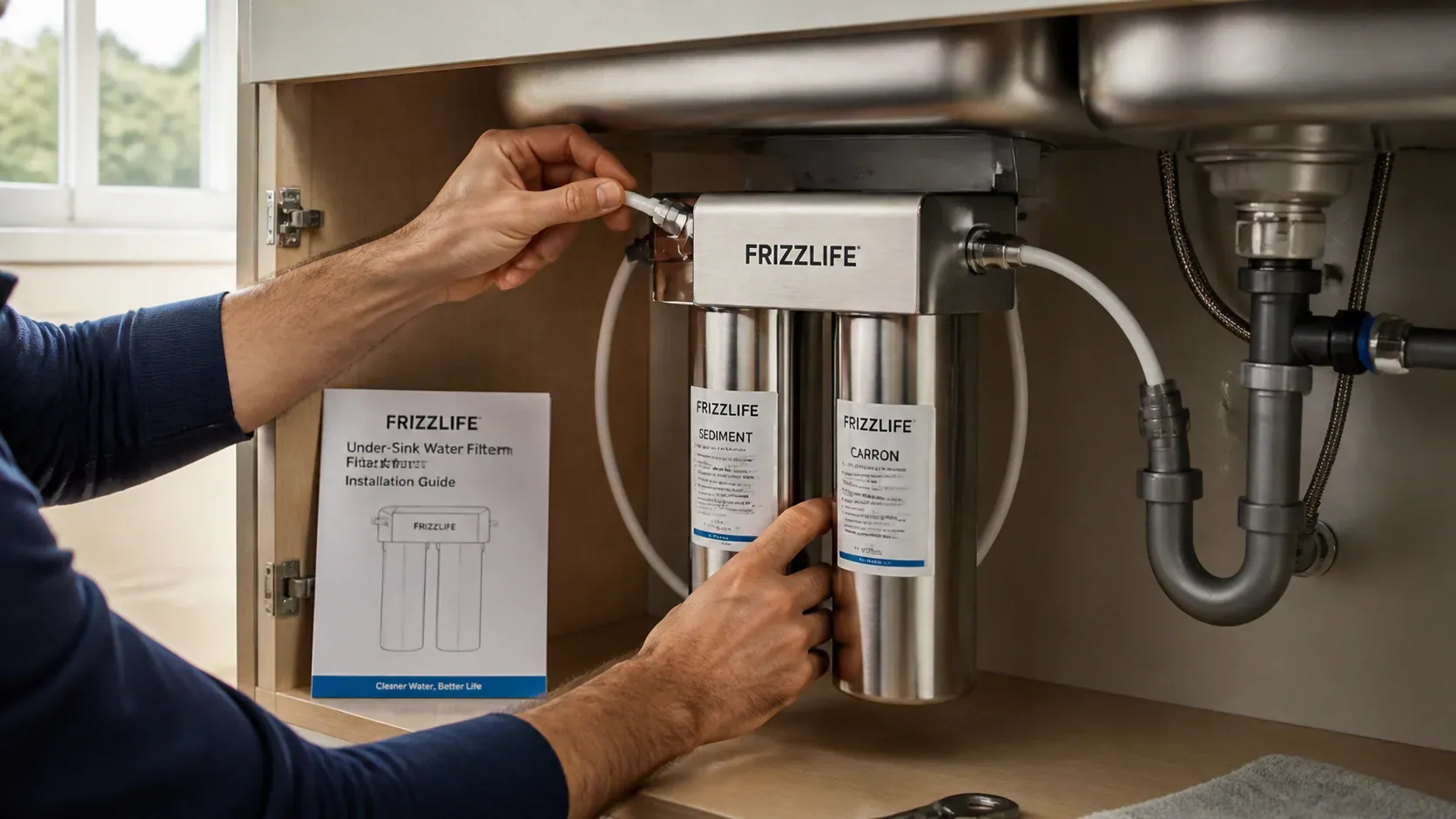
Installing your FRIZZLIFE system yourself saves money and takes just an hour or two with basic tools. Before starting, gather what you'll need: an adjustable wrench, a screwdriver, towels or a bucket to catch water, and the system components. Measure your under-sink cabinet space to ensure the filter housing fits—most installations require roughly 12 inches of height and adequate space around existing plumbing.
Begin by turning off the water supply valve under the sink and opening the faucet to release any remaining pressure. Use your adjustable wrench to disconnect the inlet and outlet tubes from your existing plumbing. Have towels ready to catch residual water from these connections.
Next, assemble the filter housing by inserting the cartridge into the main housing unit according to the manufacturer's instructions. Connect the inlet tube (typically coming from the cold water supply) to the top of the filter housing, then connect the outlet tube that runs to your faucet or refrigerator line. Secure these connections hand-tight first, then use your wrench for a final quarter-turn to ensure they're snug without over-tightening.
Mount the system to your cabinet wall or shelf using the provided brackets. This prevents movement when water pressure fluctuates and keeps the system stable during everyday use. Ensure all connections are positioned to avoid kinking or straining the tubes.
Turn the water supply back on slowly and open your faucet. Let the system run for 5–10 minutes to flush out carbon dust from the filter media—this is normal and doesn't indicate a problem. The water may appear slightly cloudy initially; this clears as flushing continues.
After flushing, turn off the faucet and check all connection points carefully for leaks. Use a flashlight to inspect the underside of the filter housing and around each tube connection. Slight moisture is normal during initial pressurization, but actual drips indicate a loose connection needing another half-turn with your wrench.
Test your water pressure by running water into a glass and noting the flow. FRIZZLIFE systems maintain strong pressure, so you should see robust flow comparable to unfiltered tap water. If pressure is noticeably weak, double-check that the inlet valve is fully open and that you haven't accidentally restricted the water line.
Understanding the Filtration Process and What Gets Removed
The multi-stage filtration inside your FRIZZLIFE system works like a sophisticated checkpoint system, with each layer removing specific contaminants. Understanding this process helps you appreciate the difference between filtered and unfiltered water—and explains why replacement timing matters.
Chlorine reduction happens in the activated carbon stage, where chlorine molecules bond to the carbon material and get trapped. This directly improves taste and odor, often the most noticeable benefit immediately after installation. The sediment filtration stage captures fine particles—rust from aging pipes, sand, and other suspended solids—that make water appear cloudy or leave residue in kettles.
Activated carbon removes organic compounds and chemical contaminants beyond chlorine, including pesticide residues and volatile organic compounds. The specific contaminants removed depend on your water's composition and which cartridge configuration you've chosen. FRIZZLIFE offers different cartridge options targeted at concerns like heavy metals, additional chlorine reduction, or enhanced sediment capture.
This multi-stage design is why layered filtration outperforms single-stage systems. A single activated carbon filter handles some chlorine removal but struggles with sediment. A sediment filter alone captures particles but misses chemical contaminants. By combining stages, FRIZZLIFE addresses the full spectrum of common household water quality issues simultaneously.
Before and after testing reveals the actual improvement your system delivers. Fill a clear glass with unfiltered tap water and another with filtered water from your FRIZZLIFE faucet. Visual differences in clarity are often striking. For more detailed analysis, water testing kits available at hardware stores quantify chlorine levels, sediment, and other parameters, providing concrete proof of your system's effectiveness.
Maintenance Schedules and Filter Replacement Timelines
Tracking filter usage forms the foundation of an effective maintenance routine. The most reliable method is monitoring gallons filtered rather than relying solely on calendar months, since usage varies dramatically between households. A family of four using 100 gallons daily will exhaust a 3,000-gallon cartridge in just 30 days, while a household of two might stretch the same cartridge to 45 days.
Watch for signs that replacement timing has arrived. Declining flow rate is the clearest indicator—if water pressure gradually weakens over weeks, your cartridge is likely nearing saturation. Taste or odor changes signal that activated carbon has become overwhelmed and can no longer effectively remove chlorine and other contaminants. Some systems include pressure gauges that visually indicate when replacement is needed.
Water quality significantly affects replacement frequency. Households with hard water, high sediment content, or water supplied from wells typically need more frequent cartridge replacements because the filters work harder. Municipal water supplies generally allow longer intervals, though older neighborhoods with aging infrastructure may have higher sediment levels requiring more frequent changes.
Replacing the cartridge requires no special tools for most FRIZZLIFE models. Simply turn off the water supply, open the faucet to release pressure, unscrew the housing (typically by hand or with a simple wrench), and slide out the old cartridge. Insert the new one, screw the housing closed, turn the water back on, and flush for a few minutes. The entire process takes under ten minutes.
Proper disposal of used cartridges matters environmentally. While most cartridges end up in landfills, some recycling programs accept activated carbon filters. Contact local waste management services or check manufacturer recommendations for responsible disposal options.
Create a maintenance calendar marking your replacement schedule before installing your first cartridge. Set phone reminders for 80% of your cartridge's expected lifespan—if your filter should last 3,000 gallons and your household uses 60 gallons daily, set a reminder for approximately 40 days. This proactive approach prevents the surprise of degraded water quality.
Budgeting for replacement filters over time helps justify the upfront system cost. If replacement cartridges cost $30–$50 and you need three to four per year, annual replacement expenses run $90–$200. Over five years, that's $450–$1,000 in cartridge costs plus the initial system investment—still significantly cheaper than bottled water purchases or frequent pitcher filter replacements for the same household.
Maximizing Filter Lifespan and Performance
Strategic pre-filtration extends your FRIZZLIFE system's operational life substantially. Households with well water or high-sediment municipal supplies benefit enormously from installing an inexpensive sediment pre-filter before the main system. This first-stage capture removes the heaviest particle load, allowing your primary cartridges to focus on chemical contaminants rather than exhausting quickly on sediment removal.
Water usage patterns directly impact how long each cartridge lasts. Households that consume 150 gallons daily exhaust filters faster than those using 50 gallons—it's simple mathematics. Understanding your household's typical water consumption helps you predict replacement timing accurately and avoid the frustration of suddenly degraded water quality.
Temperature fluctuations affect filter performance and efficiency in subtle ways. Extremely cold water reduces flow rates slightly while very hot water accelerates the saturation of activated carbon. Though residential water temperatures rarely reach extremes, being aware of these effects explains minor seasonal variations in performance.
Avoiding common mistakes prevents premature cartridge failure. Never install a filter designed for well water on a municipal supply where it's unnecessary, as this wastes cartridge capacity. Don't exceed the system's maximum flow rate by using it with high-pressure fixtures, as this forces water through the cartridge too quickly for effective filtration. Never store a system in freezing conditions, as ice expansion can damage the housing.
Flow rate monitoring provides early warning of declining performance. Test pressure regularly by filling a one-liter container and noting how long it takes. If this time increases noticeably over weeks, your cartridge is likely saturating. Declining pressure indicates the filtration media has become clogged and replacement should be scheduled soon.
Storage tips matter if you need to temporarily shut down your system—during travel, renovations, or seasonal vacancy. Turn off the water supply valve and open the faucet to depressurize the system. This prevents water stagnation inside the cartridge, which could affect water quality or promote bacterial growth during extended downtime. When restarting, flush the system for 5–10 minutes to clear any stale water.
Extending filter life through proper system maintenance involves nothing more complex than keeping connections snug, monitoring flow rate, and tracking cartridge age. Every three to six months, inspect the area under your system for leaks or moisture, tighten any loose connection fittings slightly, and verify that mounting brackets remain secure. These small maintenance steps prevent problems that might compromise water quality or waste filter capacity.
Your Next Steps Toward Cleaner, Better-Tasting Water
The FRIZZLIFE under-sink water filter represents a practical investment in your household's daily water quality that delivers on multiple fronts—from improved taste and odor to measurable contaminant reduction. Your path forward is straightforward and actionable.
Start by assessing your current water quality. Identify which contaminants concern you most: chlorine taste, sediment visibility, general water quality, or specific concerns like heavy metals. Measure your under-sink cabinet space to ensure a FRIZZLIFE system fits comfortably. Research which model aligns with your household's daily water consumption, your local water quality issues, and your budget.
Work through the installation guide at your own pace—the process is manageable for anyone comfortable with basic household tasks. Before installing your first cartridge, establish a replacement schedule so you never catch yourself with degraded water quality because you missed the signs. Use the troubleshooting information provided to address any minor issues confidently.
The difference between mediocre water and genuinely clean, great-tasting water happens one filtered gallon at a time. It starts with taking that first step today.
Get started with the FRIZZLIFE under-sink water filter and experience cleaner water in your home.