Launch X431 V+ Scanner: Independent Mechanic's Diagnostic Tool
Master vehicle diagnostics without dealer dependency. Discover how the Launch X431 V+ diagnostic scanner empowers independent mechanics with professional-grade features, bi-directional control, and multi-brand vehicle support.
Beyond Basic Code Reading—Special Functions That Drive Revenue
The gap between reading fault codes and solving problems is where independent shops hemorrhage opportunity. Most diagnostic scanners stop at P0401—exhaust gas recirculation fault detected. The X431 V+ goes further. It doesn't just tell you what's broken; it gives you the tools to fix it, verify the fix, and charge accordingly.
Oil Reset Capabilities and Customer Upsell Opportunities
Modern vehicles track maintenance intervals electronically. When a customer completes an oil change, their dashboard still shows service required until the system is reset. Independent shops typically send customers to dealerships for this simple task—dealerships that charge $75–$150 for five minutes of work. The X431 V+ performs oil resets across Toyota, Honda, BMW, Mercedes-Benz, Volkswagen, Ford, and Chevrolet platforms. Suddenly, that becomes a $25–$40 service your shop performs in-house, bundled with every oil change. Over a year, a shop performing 50 oil changes monthly generates an extra $15,000–$24,000 in revenue from a single feature.
EPB (Electronic Parking Brake) Calibration for Newer Vehicle Models
Electronic parking brakes are standard on luxury and mid-range vehicles manufactured after 2015. When servicing brake components, these systems require recalibration—a procedure that historically demanded dealership access. EPB calibration through the X431 V+ opens a service category that customers expect independent shops to handle. Shops report charging $150–$300 for EPB calibration, depending on vehicle platform and service complexity.
SAS (Steering Angle Sensor) Calibration Procedures
Modern stability control and collision avoidance systems depend on steering angle sensor accuracy. Any steering component replacement—tie rods, steering racks, wheel alignments—technically requires SAS calibration. Many shops skip this step or send customers to dealerships. The X431 V+ performs SAS calibration across dozens of platforms, transforming a compliance issue into a revenue opportunity. Shops charging $75–$150 for SAS calibration see customers choosing in-house service over dealership referrals.
DPF (Diesel Particulate Filter) Regeneration and Maintenance
Diesel vehicles dominate commercial fleets, and DPF regeneration is a recurring maintenance requirement that dealerships charge premium rates for—often $300–$600 per regeneration cycle. The X431 V+ manages forced DPF regeneration on diesel platforms, enabling independent shops to capture this high-margin work. Fleet managers actively seek independent shops offering DPF services at competitive rates, translating to steady, repeat business.
Throttle Adaptation and Idle Learning Functions
After throttle body cleaning, fuel injector service, or electronic throttle replacement, modern vehicles require throttle adaptation and idle learning procedures. Without these functions, customers experience rough idle, hesitation, or stalling—conditions that return them to the shop with complaints. The X431 V+ automates these adaptations, ensuring repairs stick the first time and preventing callback work that erodes profitability.
How Special Functions Differentiate Your Shop from Competitors
A competitor down the street performs diagnostics and basic repairs. Your shop performs diagnostics, repairs, and specialized calibrations that competitors can't touch. Customers perceive this as technical excellence and willingness to invest in their vehicles properly. This perception justifies higher labor rates and generates word-of-mouth referrals to shops that "actually fix things right."
Pricing Strategy for Special Function Services
Special functions create tiered pricing opportunities. A basic diagnostic remains $100–$150. Adding oil reset to scheduled maintenance is $25–$40. EPB calibration, SAS calibration, and DPF regeneration command $150–$300 each. Shops bundling multiple special functions into comprehensive service packages see average ticket values increase by 30–50%, directly flowing to bottom-line profit.
Documentation and Customer Communication for Advanced Services
The X431 V+ generates detailed diagnostic reports that build customer confidence. When a technician shows a customer the live data stream proving their oxygen sensor is failing, or demonstrates DPF regeneration completion with before-and-after data, customers understand the value of professional diagnostics. This transparency justifies service costs and builds loyalty.
Explore Launch X431 V+ special function capabilities today
Multi-Brand Vehicle Coverage—Asian, European, and American Platforms
A scanner that works on half the vehicles in your service bay creates tension with customers. Independent shops serve diverse fleets: construction companies running Ford F-Series trucks, urban technicians working on Honda Civics, and luxury-focused shops handling BMW 5-Series sedans. Coverage gaps mean referring work to competitors or declining jobs.
Comprehensive Support Across Toyota, Honda, BMW, Mercedes-Benz, Volkswagen, Ford, Chevrolet, and More
The X431 V+ supports diagnostics across Asian staples like Toyota, Honda, Nissan, Hyundai, and Kia; European platforms including BMW, Mercedes-Benz, Audi, Volkswagen, and Volvo; and American brands like Ford, Chevrolet, GMC, and Dodge. This tri-continental reach means most vehicles rolling into an independent shop find compatible diagnostics waiting. The breadth of coverage eliminates the "I can't help you" conversation that drives customers to dealerships.
Regional Software Packages and What They Include
The X431 V+ ships with regional software configurations. North American packages emphasize domestic and Japanese brands with strong regional presence. European packages prioritize German and Scandinavian platforms. Asian packages focus on domestic and Japanese vehicles. Independent shops should verify their regional package covers their customer base, with options to purchase additional regional modules if needed.
Coverage Depth for Luxury and Mainstream Brands
Mainstream brands receive deeper coverage than luxury marques, but the X431 V+ handles diagnostics on most luxury platforms. BMW and Mercedes-Benz coverage includes engine, transmission, ABS, airbag, and infotainment systems. Porsche, Jaguar, and Range Rover support varies by model year and software version. Shops specializing in luxury vehicles should confirm specific platform compatibility before purchase.
Compatibility with Hybrid and Electric Vehicle Diagnostics
Hybrid systems from Toyota, Honda, and Lexus, plus electric vehicles from Tesla (through third-party integrations) and plug-in hybrids across platforms, are increasingly common. The X431 V+ supports hybrid and electric vehicle diagnostics on most platforms, though some newer EV-specific systems may require dealership tools. As EV adoption accelerates, this capability becomes increasingly valuable for shops serving modern fleets.
Model Year Range Supported (Older Versus Newest Platforms)
The X431 V+ handles vehicles from approximately 2000 forward, with full functionality on 2010+ models. Earlier vehicles may lack electronic systems compatible with full diagnostic scanning, but the X431 V+ supports OBD-II code reading across all 1996+ vehicles. Newest platforms receive software support shortly after market release, ensuring your tool remains relevant as manufacturers introduce new models.
Gaps in Coverage and Workaround Strategies
No single scanner covers everything. Some specialty vehicles, heavily modified platforms, and bleeding-edge models may fall outside X431 V+ coverage. When gaps appear, shops establish relationships with dealership technical support, join online diagnostic communities sharing workaround procedures, or invest in platform-specific tools for niche markets. Acknowledging gaps honestly with customers builds trust and prevents costly diagnostic rabbit holes.
Software Update Frequency and Expansion of Vehicle Databases
Launch regularly releases software updates expanding vehicle coverage and adding new features. Shops with active internet connectivity receive updates automatically, or manually download updates during maintenance windows. Update frequency typically ranges from monthly to quarterly, ensuring the X431 V+ stays current with new model releases and emerging diagnostic procedures.
Real-World Shop Scenarios Where Broad Coverage Saves Time
A general repair shop in a suburban market serves everything from 15-year-old Civics to brand-new Range Rovers. Broad coverage means diagnostic procedures are standardized—the same tool, same workflow, same technician confidence across the entire customer base. Compare this to a shop with multiple scanning tools, where technicians must remember which tool handles which brands, wasting time switching equipment and increasing diagnostic errors. Broad coverage centralizes workflow and maximizes technician productivity.
Bi-Directional Control—Active Testing and Repair Verification
Reading codes is passive. Controlling vehicle systems to verify repairs is active. This distinction separates professional diagnostics from guesswork.
Understanding Bi-Directional Capability Versus Read-Only Scanning
Read-only scanners display what the vehicle's computers know. A technician sees "P0134 O2 sensor circuit no activity" and knows the oxygen sensor needs replacement. Bi-directional tools go further—they command the vehicle to perform actions, allowing technicians to verify components respond correctly. This eliminates diagnostic guessing and accelerates root-cause identification.
Actuator Testing for Engine Components, HVAC Systems, and Lighting
Bi-directional control allows technicians to trigger fuel injector pulses, activate cooling fan operation, command door lock actuators, and test lighting circuits individually. A technician troubleshooting a power window can command the motor to operate, isolating whether the problem is electrical, mechanical, or control module-related. This targeted testing reduces diagnostic time from hours to minutes.
ECU Reprogramming and Module Configuration Options
Modern vehicles handle configuration changes through ECU reprogramming. Changing a comfort module configuration to disable automatic headlights, adjusting throttle response parameters, or updating module software is handled through bi-directional capability. The X431 V+ manages reprogramming on supported platforms, eliminating dealership referrals for routine configuration adjustments.
Live Data Streaming for Real-Time System Monitoring
Watching live data as a vehicle operates reveals patterns invisible in static code readings. A technician seeing oxygen sensor voltage waveforms dance across the screen during acceleration understands system response dynamics. Live data streaming catches intermittent faults, verifies sensor responsiveness, and confirms repairs worked correctly. Most professional diagnostics depend on live data analysis for root-cause confirmation.
How Active Testing Reduces Diagnostic Time and Guesswork
A customer reports rough idle. Without bi-directional testing, a technician might replace the fuel filter, clean injectors, and replace the air filter—three parts costing $300 in labor and materials. With bi-directional testing, the technician triggers fuel injector pulses and observes response data, discovering an injector isn't firing. One $150 injector replacement solves the issue. Bi-directional testing converts random troubleshooting into targeted diagnosis.
Safety Considerations When Performing Bi-directional Functions
Commanding vehicle systems carries risks. Activating cooling fans drains battery charge. Triggering starter motor testing risks accidental engine cranking. Running ECU reprogramming requires proper power management to prevent module corruption. Technicians must understand which bi-directional functions are safe to perform, under what conditions, and how to prevent damage. Proper training transforms bi-directional capability from liability into asset.
Training Requirements for Technicians Using Advanced Features
The X431 V+'s bi-directional functions demand technician competence. Training should cover basic operation, which functions are safe for your shop's technicians to perform, proper power management during reprogramming, and safety protocols for high-risk procedures like ECU updates. Launch provides video tutorials, webinars, and documentation, but hands-on shop mentorship accelerates proficiency.
Case Studies: Repairs Solved Faster with Bi-Directional Control
A transmission shop receives a vehicle with intermittent transmission slipping. Without bi-directional control, diagnostic time extends as technicians attempt to recreate the problem through road testing. With bi-directional control, the technician commands transmission solenoid actuation sequences and monitors pressure sensor feedback in real time, discovering a solenoid isn't responding correctly. Three hours of diagnosis versus thirty minutes—that's bi-directional advantage in practice.
The Hardware Package—Tablet, VCI, and Connectivity
The X431 V+ hardware experience shapes daily workflow satisfaction and diagnostic accuracy.
10-Inch Android Touchscreen Specifications and User Interface Design
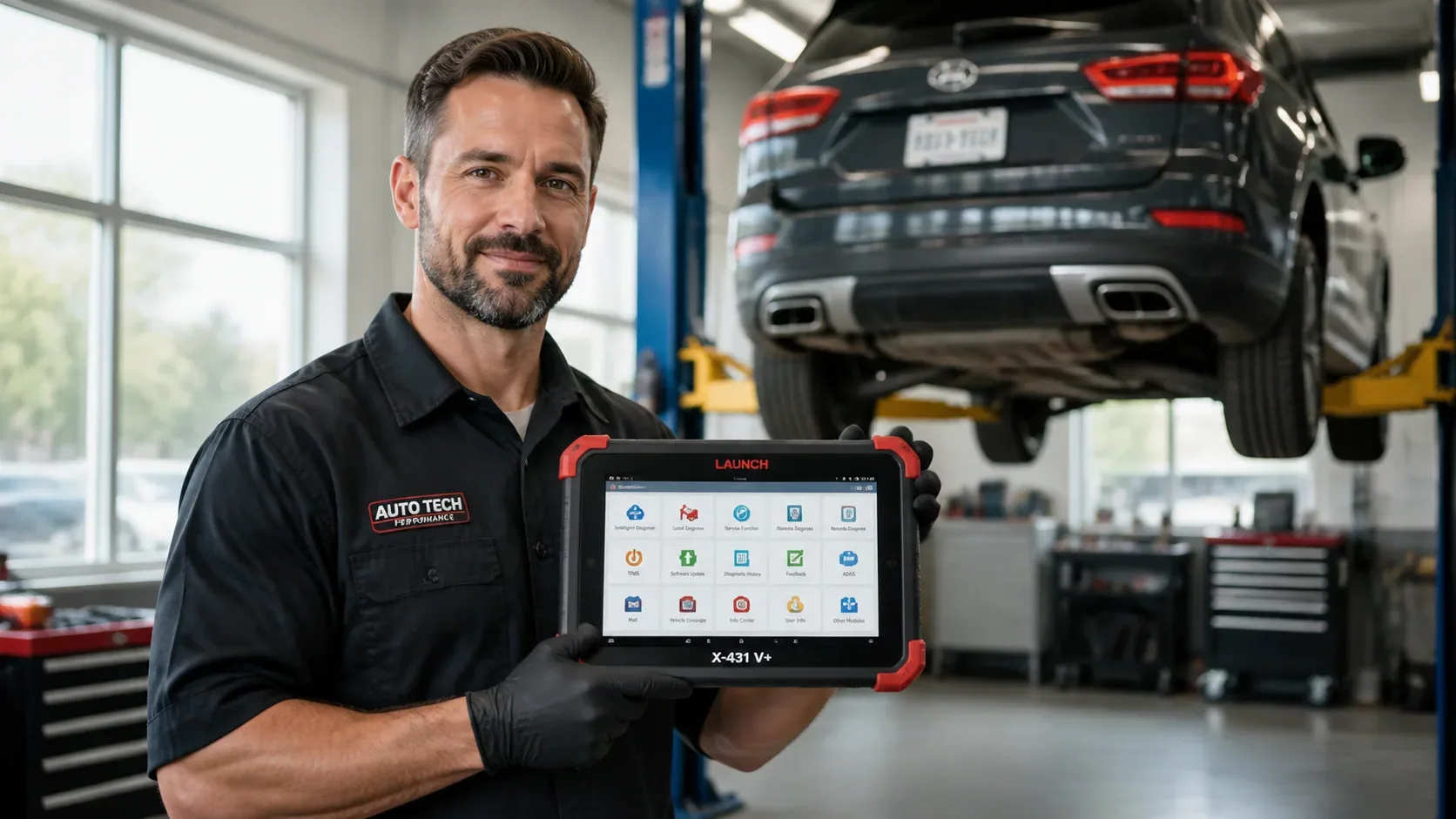
The package includes a 10-inch Android tablet with capacitive touchscreen, adequate for displaying live data streams, waveform charts, and system hierarchies simultaneously. Screen size balances portability with readability—technicians see enough detail without requiring desktop monitors. The user interface prioritizes logical navigation, with vehicle selection, system browsing, and function execution following intuitive workflows that accelerate proficiency.
Wireless Bluetooth VCI (Vehicle Communication Interface) Range and Reliability
The wireless Bluetooth VCI eliminates cable entanglement and enables technicians to work freely around vehicles. Bluetooth range typically extends 30–50 feet, accommodating shop bays where the tablet rests on workbenches while the VCI connects to vehicles. Reliability improves with each hardware revision, though occasional reconnection delays occur in shops with high wireless network density.
Processing Power and Responsiveness During Complex Diagnostics
The tablet processor handles simultaneous live data streaming, waveform rendering, and data logging without noticeable lag. Complex diagnostics on newer vehicles with dozens of networked modules still perform smoothly. Processing responsiveness directly impacts technician workflow—sluggish performance frustrates and slows diagnosis, while responsive performance builds confidence and accelerates completion.
Battery Life and Charging Considerations for Shop Workflow
Tablet battery life typically reaches 8–10 hours under normal diagnostic use, sufficient for a full shop day. VCI batteries last similarly. Overnight charging replenishes both devices for the next day. Shops should establish charging protocols ensuring equipment is topped up before morning shifts, preventing mid-shift power depletion during critical diagnostics.
WiFi and Cellular Connectivity Requirements for Software Updates
The X431 V+ requires internet connectivity for initial software installation and periodic updates. Most shops use WiFi networks for this purpose. Cellular connectivity is optional but useful for mobile mechanics or shops without reliable WiFi in service bays. Software updates typically consume 500 MB–2 GB depending on package scope, downloaded automatically when connected or manually scheduled during maintenance windows.
Durability and Warranty Coverage for Hardware Components
Professional-grade hardware withstands workshop environments—spilled oil, dropped tools, vibration from air tools. The tablet and VCI are ruggedized for light industrial use, though they're not military-grade waterproof devices. Standard warranty covers one year of defects, with optional extended coverage available. Shops should budget for occasional replacement if devices suffer catastrophic damage.
Comparison with Wired Versus Wireless Diagnostic Connections
Wireless connectivity offers freedom and modernization but sacrifices the absolute reliability of wired connections. Some technicians prefer wireless for flexibility; others prefer wired connections for guaranteed stability during critical procedures like ECU reprogramming. The X431 V+ supports both, allowing shops to choose based on preference and workflow requirements.
Tablet Storage Capacity and Software Installation Requirements
The tablet typically includes 128–256 GB storage, accommodating full diagnostic software packages, updates, and data logging. Regional packages consume 20–50 GB depending on depth. Shops with multiple regional modules may require external storage expansion, accomplished through microSD card slots available on the tablet.
Software Ecosystem and Subscription Costs—Understanding the True Investment
Hardware is half the equation. Software determines capability, and software carries costs that extend beyond purchase price.
Base Package Inclusions Versus Optional Add-On Modules
The X431 V+ base package includes general diagnostics for supported vehicle platforms—code reading, live data, basic bi-directional functions. Optional add-ons include special function modules (oil reset, EPB calibration, DPF regeneration), advanced ECU reprogramming packages, and expanded regional vehicle databases. Shops should map their customer base and anticipated service offerings against available modules, building a configuration matching their business model.
Annual Subscription or One-Time Licensing Models
Launch uses subscription-based software licensing, typically structured as annual renewals. First-year costs include hardware and software; subsequent years renew software subscriptions at lower rates. Some functions require subscription activation, meaning discontinued subscription access means lost capability. Shops should understand licensing terms before purchase, ensuring financial planning accommodates annual renewal costs.
Regional Pricing Variations and Bundle Strategies
Pricing varies by region, with North American packages often ranging $900–$1,500 depending on bundled modules. European and Asian packages may differ in included modules and pricing. Launch frequently offers bundle promotions combining hardware, base software, and special function modules at reduced total cost, making promotional timing valuable for purchase decisions.
Cost-Benefit Analysis of Premium Software Packages
Premium packages include comprehensive special functions—oil reset, EPB, SAS, DPF, throttle adaptation—plus advanced ECU reprogramming. These packages cost more upfront but immediately unlock revenue-generating services. A shop performing 10 oil resets monthly at $30 margin generates $3,600 annually from one feature, justifying premium package investment within months.
Free Versus Paid Diagnostic Function Limitations
Some diagnostic functions are included in base packages; others require premium subscriptions. Oil reset and basic calibration procedures might be included; advanced ECU reprogramming might require additional payment. Shops should verify which functions their planned revenue model depends on and confirm availability in their software configuration.
Software Update Schedules and Feature Rollouts
Launch releases updates regularly, typically monthly or quarterly. Updates introduce new vehicle coverage, improve existing procedures, and occasionally add new features. Active internet connectivity ensures automatic updates, or manual download options available through the Launch portal.
Hidden Costs: Internet Requirements, Storage Expansion, Accessories
Beyond software subscriptions, shops should budget for accessories—diagnostic cables for specific vehicle types, tablet protective cases, replacement VCI units, microSD cards for storage expansion, and mobile charging solutions. Internet connectivity requirements mean ongoing ISP costs. These secondary expenses often exceed $500–$1,000 annually.
ROI Calculation Based on Typical Repair Shop Volume
A shop performing 50 diagnostic scans monthly at $125 average revenue generates $75,000 annual diagnostic revenue. If X431 V+ costs $1,200 initially and $400 annual subscription, the tool pays for itself within 6–7 days of operation. Additional revenue from special functions—oil reset, EPB calibration—means payback completes within weeks, delivering years of profitable operation.
Competitive Positioning—How X431 V+ Stacks Against Industry Alternatives
The diagnostic scanner market offers competing platforms, each with strengths and weaknesses.
Comparison with Autel MaxiSys and Snap-on Solus
Autel MaxiSys competes directly in price and feature range, offering similar bi-directional capability and broad vehicle coverage. Snap-on Solus occupies the premium segment with higher costs but arguably superior integration with shop management systems common in larger facilities. X431 V+ typically undercuts both on price while matching core features, making it attractive to budget-conscious independent shops.
Comparison with BlueDriver and Consumer-Grade Scanners
Consumer-grade tools like BlueDriver offer basic code reading through smartphone applications at $99–$199. These tools serve DIY users and basic diagnostics but lack professional features—no bi-directional control, no special functions, limited live data. Comparing X431 V+ to consumer tools is comparing professional diagnostics to hobby-level capabilities; they serve different markets entirely.
Price-to-Feature Ratio Analysis
The X431 V+ delivers exceptional price-to-feature value. Mid-range professional scanners cost $1,500–$3,000 and offer comparable features. High-end tools like Snap-on cost $4,000–$6,000 for incremental advantages. Relative to competitors, X431 V+ offers strong capability per dollar invested.
Ease of Use and Learning Curve for Shop Technicians
The X431 V+ prioritizes usability, with menu structures and workflow design matching technician expectations from experience with other diagnostic tools. Learning curve is typically days for basic operation, weeks for advanced proficiency. Competitors like high-end Snap-on tools often require longer training investments due to complexity.
Customer Support and Troubleshooting Resources
Launch offers email support, phone support, and video tutorial libraries. Support quality varies by region, with faster response times in major markets. Competitors like Snap-on provide on-site technical support and training, exceeding X431 V+ support availability for large operations but exceeding most independent shops' needs.
Brand Reputation and Reliability Track Record
Launch has built strong reputation among independent repair professionals over two decades. The X431 platform is battle-tested, with widespread adoption among shops globally. Reliability is solid, though occasional software bugs emerge with major updates. Competitors have similar reliability profiles, with choice often driven by specific feature preferences rather than reliability differentiation.
Warranty and Replacement Policies
Standard warranty covers one year of defects. Extended warranty options available through Launch and authorized retailers extend coverage to three years. Replacement policies are straightforward—defective hardware is replaced during warranty period. Competitors offer similar warranty structures.
When to Choose X431 V+ Over Competing Platforms
Independent shops with 1–5 bays, budget constraints, and diverse customer bases choose X431 V+ for its price-to-feature balance. Shops valuing wireless connectivity, special functions enabling revenue expansion, and broad vehicle coverage across Asian, European, and American platforms find X431 V+ optimal. Shops with existing investments in Autel or Snap-on ecosystems may prefer staying within platforms for integration reasons.
Implementation Strategy—Getting Your Team Up to Speed
Purchasing the X431 V+ is the beginning, not the end. Implementation determines whether the tool becomes a game-changer or gathers dust.
Onboarding Procedures for Existing Technicians
Start with a dedicated onboarding session, introducing the X431 V+ to technicians who'll use it daily. Cover physical device operation—powering on, connecting to vehicles, navigating menus. Explain licensing structure so technicians understand which functions are available. Assign initial exploratory time on non-critical vehicles, allowing technicians to build comfort without diagnostic pressure.
Training Resources: Video Tutorials, Webinars, and Documentation
Launch provides comprehensive training materials—video tutorials walking through common procedures, webinars addressing specific vehicle platforms or special functions, and detailed documentation for reference. Shops should allocate time for technicians to review these materials during paid work time, not asking technicians to learn on personal time.
Establishing Diagnostic Protocols and Standardized Workflows
The X431 V+ offers multiple paths to diagnose issues. Establish shop-wide protocols—consistent menu navigation sequences, standardized data collection procedures, agreed-upon escalation points when issues exceed technician comfort. This standardization accelerates competence and ensures consistent diagnostic quality across technicians.
Integration with Existing Shop Management Software
Modern shop management systems integrate with diagnostic tools, automatically logging scan data with customer records and work orders. Confirm compatibility between X431 V+ and your current shop software before purchase, or plan for manual data integration if native connections aren't available.
Creating a Knowledge Base for Common Vehicle Issues
As technicians resolve recurring issues using the X431 V+, document procedures. Build a shop knowledge base capturing diagnostic trees for common problems—rough idle diagnosis on 2010+ Honda Civics, transmission slipping diagnosis on 2015+ Toyota Highlanders. This knowledge base accelerates future diagnostics and builds organizational competence beyond individual technician expertise.
Building Confidence in Technicians Transitioning from Other Tools
Technicians experienced with other diagnostic tools may feel frustrated initially, comparing X431 V+ navigation to familiar workflows. Address this by acknowledging the learning curve, providing mentoring from initially-proficient technicians, and celebrating early wins as technicians become comfortable. Patience during transition prevents resistance.
Time Investment for Team Proficiency
Budget 40–80 hours for a technician to reach baseline proficiency, 200+ hours for advanced mastery. Proficiency varies by individual and prior diagnostic experience. Experienced technicians typically progress faster; less-experienced technicians require additional support.
Measuring Diagnostic Accuracy Improvements Post-Implementation
Track diagnostic accuracy before and after X431 V+ implementation by monitoring comeback rates—repeat visits for the same complaint. Improved diagnostic accuracy reduces comebacks, lowering costs and increasing customer satisfaction. Monitor average diagnostic time by technician, identifying performance gaps requiring additional training.
Real-World Shop Scenarios—Where X431 V+ Delivers Maximum Value
The X431 V+ solves problems differently depending on shop size, specialization, and customer base.
Independent Single-Bay Shops and Cost-Per-Diagnostic Calculations
A one-technician shop performing 50 diagnostics monthly at $125 average generates $75,000 annual diagnostic revenue. X431 V+ investment ($1,200 hardware + $400 annual software) represents 2.1% of annual diagnostic revenue—trivial cost relative to value generated. Single-bay shops see rapid ROI and discover that diagnostic capability drives additional repair work.
Multi-Location Operations and Fleet Maintenance Facilities
Shops operating multiple locations benefit from fleet licensing options, enabling multiple technicians across locations to use the same software. Fleet facilities serving commercial customers (landscaping, delivery, construction) value diagnostic consistency—every location uses identical procedures and equipment. Multi-location shops often purchase multiple X431 V+ units, deploying one per location for seamless service.
Specialty Shops (Diesel, Hybrid, Luxury Vehicles)
Diesel shops benefit enormously from DPF regeneration capability, capturing high-margin work historically lost to dealerships. Luxury vehicle shops appreciate comprehensive BMW and Mercedes-Benz diagnostics. Hybrid specialty shops leverage hybrid system compatibility. Specialization amplifies X431 V+ value because shop revenue models align perfectly with included capabilities.
Quick-Lube and Tire Shops Expanding into Diagnostics
Quick-lube and tire shops often generate thin margins on core services. Offering basic diagnostics ($100–$150 per scan) generates margin without requiring significant technician expertise. X431 V+ base packages support quick-lube expansion into diagnostics without overwhelming training requirements. Oil reset functionality bundles perfectly with oil change services.
Mobile Mechanics and On-Site Repair Services
Mobile mechanics value wireless connectivity and tablet portability—the X431 V+ enables complete diagnostic capabilities without returning to a shop bay. On-site repair services leverage the tool's independence from stationary equipment. Wireless VCI connectivity and tablet mobility make mobile diagnostics practical and profitable.
Used Car Dealerships and Pre-Purchase Inspections
Used car dealers employ X431 V+ for pre-purchase inspections, systematically checking all vehicle systems before listing inventory. Comprehensive diagnostics identify issues requiring repair before retail sale, protecting dealer reputation. Some dealers charge customers for detailed inspection reports, converting diagnostics into revenue stream.
Warranty Work and Insurance Claim Documentation
Warranty work requires detailed diagnostic documentation proving repair necessity. Insurance claim work benefits from comprehensive data demonstrating damage scope. X431 V+ generates detailed reports suitable for warranty administrators and insurance adjusters, supporting claims and reducing disputes.
Emergency Diagnostics and Customer Retention Strategies
When customers arrive with urgent problems, rapid diagnostics determine if you can solve issues or must refer them elsewhere. X431 V+ capability enables quick problem identification, either resolving issues immediately or explaining why referral is necessary. Customers remember shops that attempted solutions rapidly; this generates retention and word-of-mouth referrals.
Addressing Limitations and Workarounds
No diagnostic tool is perfect. Understanding X431 V+ limitations and available workarounds prevents frustration and manages customer expectations.
Vehicle-Specific Diagnostic Gaps and Manufacturer Restrictions
Certain vehicles or systems fall outside X431 V+ coverage despite regional software packages. Some manufacturers restrict diagnostic access to dealerships through proprietary protocols. Some cutting-edge electric vehicles lack third-party diagnostic support. When gaps appear, inform customers honestly that specialized resources are required, avoiding futile diagnostic attempts that waste time and build frustration.
Software Limitations on Certain Model Years or Platforms
Older vehicles (pre-2000) may lack electronic systems compatible with full diagnostic scanning. Some obscure platforms or regional market vehicles might receive limited support. Model year cutoffs typically hover around 1996 for OBD-II compatibility, with full functionality on 2010+ vehicles.
Internet Dependency for Initial Setup and Regular Updates
Initial software installation and regular updates require internet connectivity. Shops without reliable WiFi should establish update procedures using mobile hotspots or wired connections during maintenance windows. Plan updates strategically, avoiding diagnostic disruptions during peak shop activity.
Occasional Compatibility Issues with Aftermarket Modifications
Heavily modified vehicles with aftermarket engine management systems, standalone ECUs, or non-OEM components may not communicate properly with X431 V+ diagnostics. This is universal to all aftermarket OBD-II tools, not X431 V+-specific. Document modifications when they prevent diagnostics, adjusting service estimates accordingly.
When to Escalate Diagnostics to Dealership Resources
Establish decision criteria for escalation. If X431 V+ cannot identify root cause after reasonable diagnostic time, if procedures require manufacturer-specific tools unavailable elsewhere, or if repairs exceed shop capability, escalate to dealership resources. This prevents sunk diagnostic costs and maintains customer relationships.
Building Relationships with Dealership Technical Support
Dealerships occasionally provide technical support to independent shops, especially for problematic cases. Cultivate relationships with local dealership service managers, establishing informal referral networks where complex diagnostics flow to appropriate specialists. Reciprocal referrals strengthen community relationships and improve customer outcomes.
Subscription Renewal and Long-Term Cost Planning
Annual subscription renewals require budgeting. Shops should track renewal dates, ensuring payments process timely to prevent service interruption. Budget $300–$500 annually for software subscriptions, plus periodic hardware replacement or repair costs.
Storage and Backup Strategies for Diagnostic Data
Diagnostic data—scan results, live data logs, repair history—should be backed up regularly. Tablet storage can fill with accumulated data, requiring periodic cleanup. Establish data archival procedures, perhaps uploading completed jobs to cloud storage or external hard drives, maintaining both current accessibility and historical records.
Making the Purchase Decision—ROI and Shop Profitability Impact
The final question is whether X431 V+ investment makes financial sense for your specific shop.
Break-Even Analysis Based on Diagnostic Service Pricing
If your shop charges $125 per diagnostic and the X431 V+ costs $1,200 initially plus $400 annual software, the tool breaks even after 11 diagnostics (assuming $100 net margin per diagnostic after costs). Most independent shops complete 11 diagnostics within two weeks of normal operation, meaning break-even occurs within days.
Calculating Payback Period for $900–$1,500 Investment
Conservative analysis: Assume your shop currently performs 40 diagnostics monthly. X431 V+ adds minimal additional diagnostic volume initially, but special functions like oil reset, EPB calibration, and DPF regeneration generate 15–20 additional billable procedures monthly. At average margins of $50–$100 per procedure, additional monthly revenue reaches $750–$2,000. Payback period for $1,200 initial investment is less than two months.
Revenue Impact from Expanded Service Offerings
Special functions transform diagnostic services into revenue drivers. Oil reset bundled with every oil change adds $25–$40 per service. EPB calibration adds $150–$300 per occurrence. DPF regeneration adds $300–$600 per occurrence. Shops actively marketing these services report 20–40% increase in service ticket values within first year.
Customer Satisfaction Improvements and Repeat Business
Accurate diagnostics reduce repeat visits for the same complaints. Faster diagnostics minimize customer inconvenience. Comprehensive special functions demonstrate shop professionalism and invest customer confidence. These factors combine to increase repeat business and customer referrals, indirect revenue impacts exceeding direct diagnostic revenue.
Competitive Advantage in Your Local Market
Competitors without advanced diagnostic tools cannot match your service breadth. Shops actively marketing diagnostic capability gain perception as technically advanced and customer-focused, attracting customers from shops with outdated equipment. This competitive advantage strengthens customer retention and market position.
Financing Options and Payment Plans
Launch and authorized retailers frequently offer financing—paying off equipment over 12–24 months rather than lump-sum purchase. Monthly payments of $50–$100 distribute investment across multiple months, reducing initial cash outlay. Financing makes equipment investment accessible for smaller shops or those managing cash flow constraints.
Warranty Coverage and Protection Plans
Standard one-year warranty covers defects. Extended three-year plans cost $200–$300 additional, protecting against accidental damage and component failure beyond manufacturing defects. Shops with tight operating margins might skip extended warranty; shops unable to afford unexpected equipment replacement should invest in protection plans.
Upgrade Paths and Future-Proofing Your Investment
The X431 V+ receives regular software updates expanding capabilities without hardware replacement. Future vehicle models are supported through software updates, extending tool relevance for years. Hardware upgrades may eventually be necessary (tablet refresh, VCI replacement), but core investment remains useful beyond five-year depreciation cycles typical for diagnostic tools.
The Path Forward: Securing Your Shop's Diagnostic Independence
The Launch X431 V+ represents more than a scanning device—it's your shop's independence from dealership diagnostic gatekeeping. When you control diagnostics, you control customer retention, service pricing, and repair profitability. Independent shops losing $15,000 annually to dealership diagnostic referrals can recapture that revenue by mastering their own diagnostics.
The investment calculus is compelling. A $1,200–$1,500 tool generating $75,000+ annual diagnostic revenue pays for itself within days, then delivers years of profitable operation. Special functions transform diagnostics into a competitive weapon, allowing independent shops to offer services that dealerships reserve for their captive audiences. Bi-directional capability reduces diagnostic time, accelerates repairs, and improves first-time-right success rates that build customer loyalty.
Implementation requires investment beyond purchase price—technician training, workflow establishment, potential integration with shop management systems—but this infrastructure investment transforms tools into competitive advantages. Shops that thoroughly train technicians and establish standardized diagnostic protocols extract maximum value from equipment investment.
Start by evaluating your current diagnostic bottlenecks. Which customers currently require dealership diagnostics? Which special functions would your customers pay premium prices for? Which vehicle platforms dominate your customer base? Answer these questions and the X431 V+ value proposition becomes self-evident. The independent repair industry is evolving toward shops equipped with professional-grade diagnostic tools; shops without advanced capability are gradually marginalized. The X431 V+ positions you to compete confidently, serve customers better, and grow your bottom line.
Secure your shop's diagnostic independence with